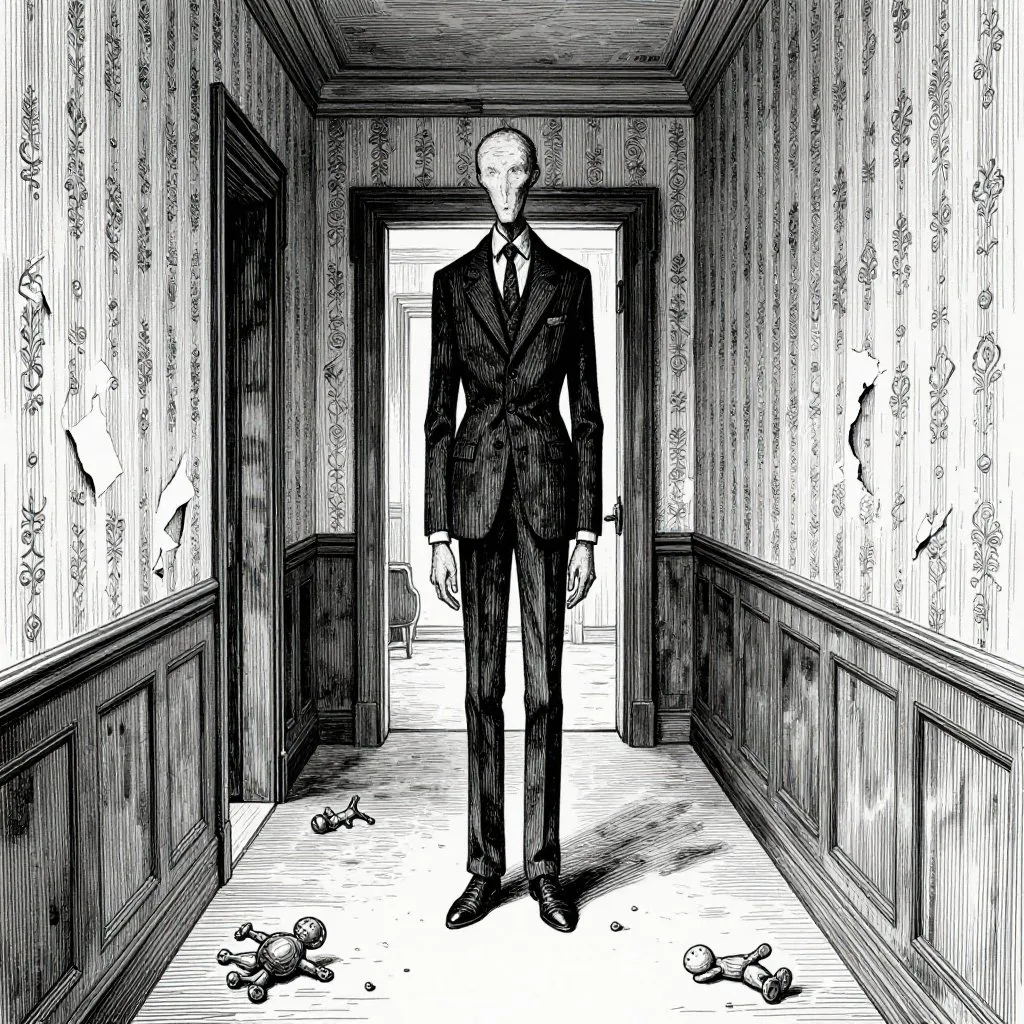
The Forum Post
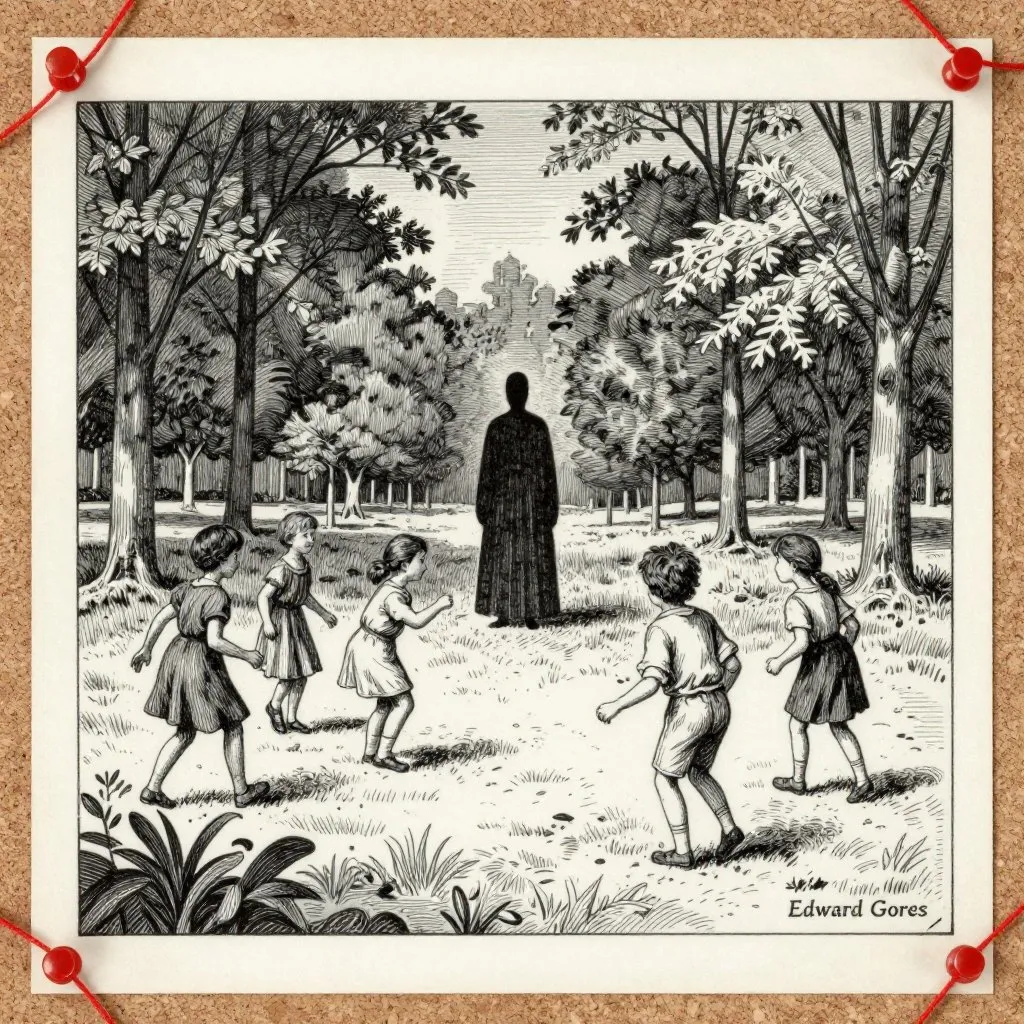
On June 10, 2009, a user named Victor Surge posted two photographs to the Something Awful internet forum. The photos showed groups of children. Playing in a park. Gathered near a school. The kind of ordinary images that existed by the billions in 2009, unremarkable in every way except for one detail: in the background of each, at the edge of the frame, a tall thin figure in a dark suit stood among the trees. Too tall. Too thin. Arms that hung wrong. Where its face should have been, there was nothing at all.
The thread was a Photoshop contest. The prompt was simple: create paranormal images that looked real. Victor Surge, whose name is actually Eric Knudsen, submitted his entries and typed fictional captions in the style of recovered historical documents. Then he closed the browser and went about his day.
He won. Not officially. There were no prizes. But he won in the only way that matters on the internet: people remembered his entry and forgot everyone else's. By the time the thread was archived, something had already started. The figure in the photographs had no name yet. It had no backstory. It had no rules. What it had was a blank face and an uncanny stillness, which turned out to be more than enough.
The creature would come to be called Slenderman. The name arrived quickly, the way these things do online, with a confidence that suggested it had always been the right answer. Nobody voted on it. Nobody filed paperwork. One day there was a tall faceless thing in a suit, and then there was a name, and then there was everything that followed.
The Growth
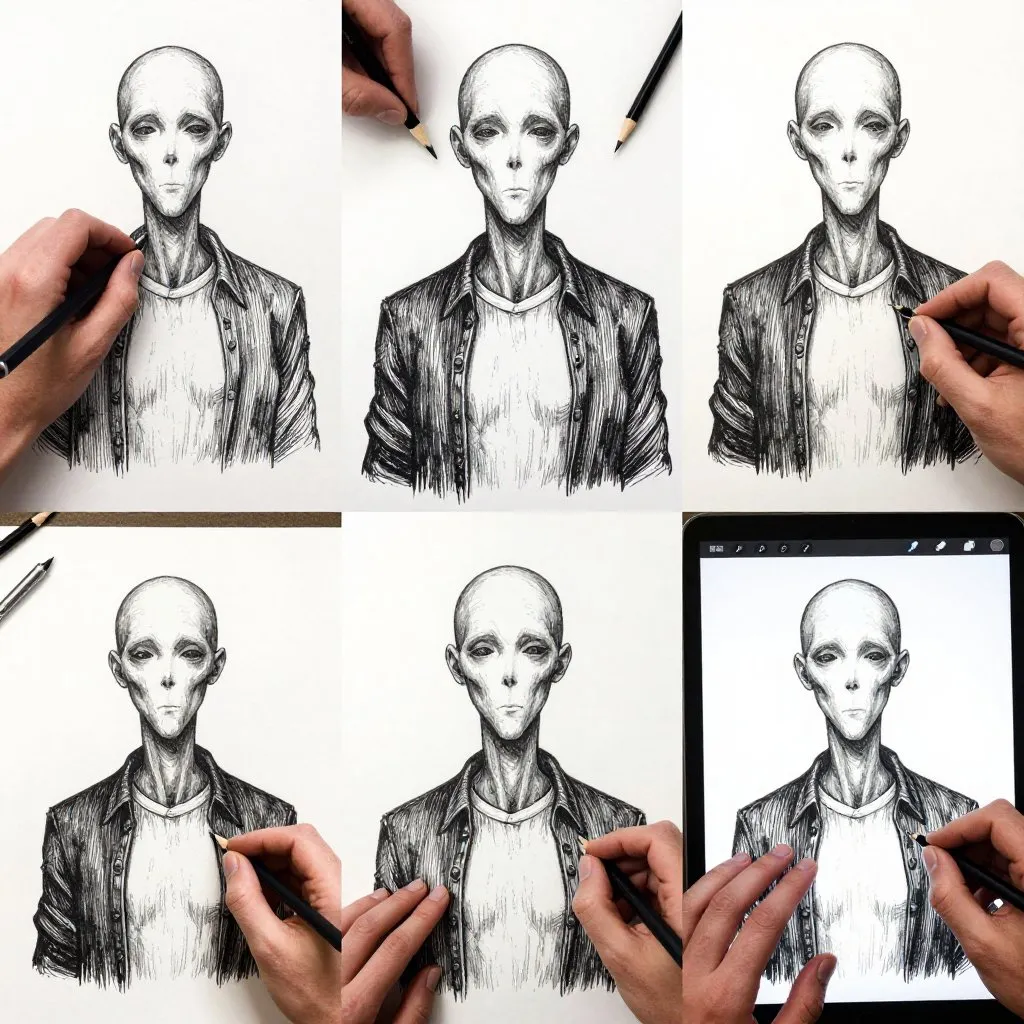
The internet in 2009 was a particular kind of place. Forums. Comment sections. Wikis that anyone could edit. Content moved fast and credit moved slowly, which created the conditions for exactly this kind of thing. Within weeks of Victor Surge's post, other users had begun adding to the mythology. Not as a coordinated project. Just because they wanted to.
Stories appeared. Short fiction, written in the same deadpan documentary style as the original captions. Drawings appeared, each artist's version slightly different, but all sharing the essential qualities: the height, the suit, the absence of a face. Short films appeared on YouTube, shot in dark forests by teenagers with consumer cameras and a genuine gift for dread. The Slenderman had no official owner, no copyright protection, no single authority. He was open-source horror, which is both the best and most dangerous kind.
The backstory assembled itself through collective effort. He stalked children. He caused memory loss and paranoia in those who saw him. He could teleport and appear in the background of photographs without being noticed until later, which gave every old photograph a new and unwanted layer of scrutiny. His face was blank, which meant every viewer projected their own specific fear onto the space where features should have been. He wore a suit, which made every man in a suit slightly more concerning than before. Every design choice, including the ones nobody consciously made, turned out to be correct.
Academic researchers who study digital folklore would later describe Slenderman as the first true "emergent mythology" of the internet age. A story that assembled itself from thousands of contributors with no central author and no official canon, functioning exactly the way oral tradition had functioned for thousands of years, except it happened in eighteen months instead of eighteen generations. This is either remarkable or terrifying. Possibly both.
The Games
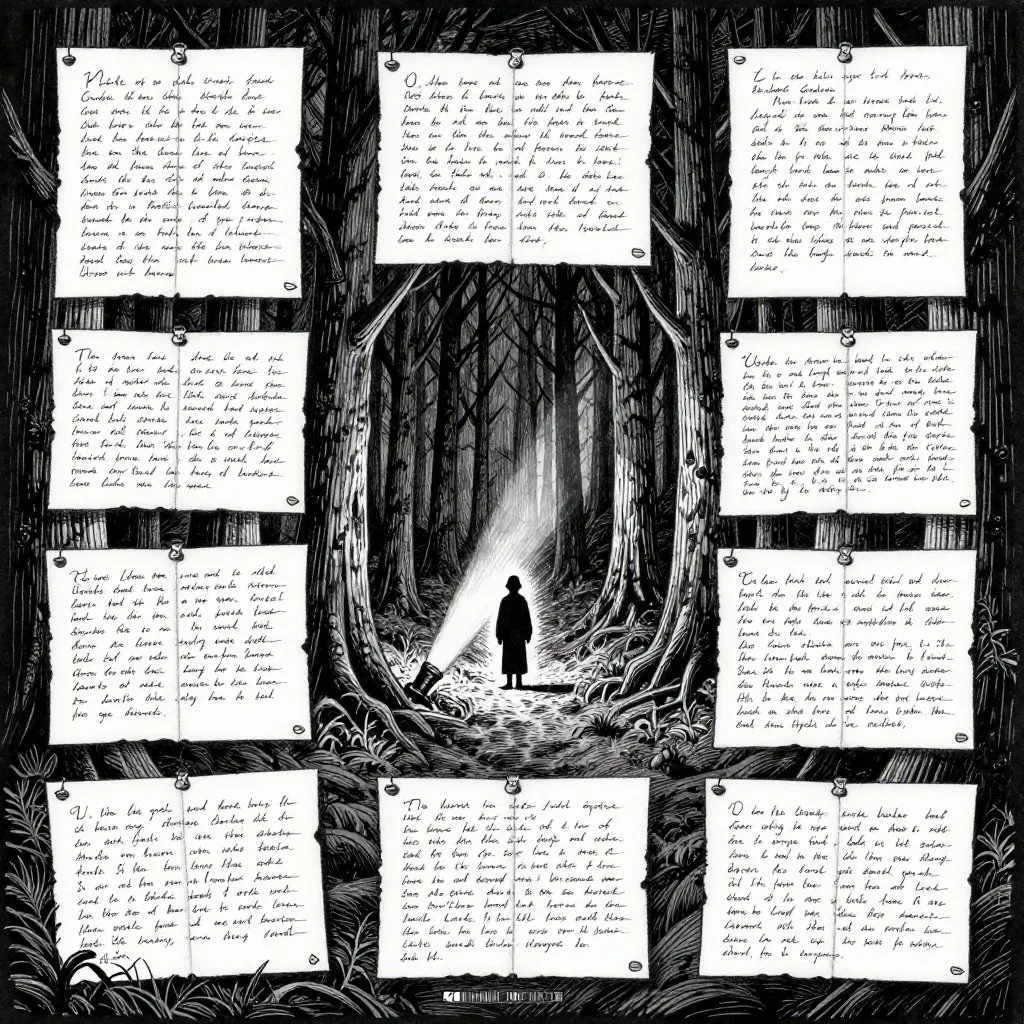
In June 2012, a developer named Mark Hadley released a free horror game called "Slender: The Eight Pages." The premise was minimal: you are alone in a dark forest at night. Someone has left eight pages of notes nailed to trees. Collect them. Do not get caught. There is no weapon. There is no combat system. There is no way to fight back. There is only the forest, the flashlight, and the thing moving between the trees.
The game was downloaded over two million times in its first month. This was not because the graphics were exceptional, because they were not. It was not because the gameplay was complex, because it was not. It was because the game understood something that most horror gets wrong: the imagination is worse than anything you can show. The Slenderman in "The Eight Pages" barely appears. He is a flicker at the edge of the frame. A shape between trees that was not there a moment ago. The game made you afraid of looking and equally afraid of not looking, which is a specific kind of misery that people apparently paid nothing for in enormous numbers.
YouTube at this point was fully operational as an economy of reaction. Gaming channels filmed themselves playing "The Eight Pages" in the dark, narrating their growing terror, and then screaming when the game ended their run. These videos accumulated hundreds of millions of views. People watched other people be frightened, which made them frightened, which made them want to watch more. Slenderman had crossed from internet mythology into interactive entertainment, and from interactive entertainment into a content format, which is either the pinnacle of cultural penetration or a sign that something had gone slightly sideways. The suits at Sony Pictures were paying attention.
The Stabbing
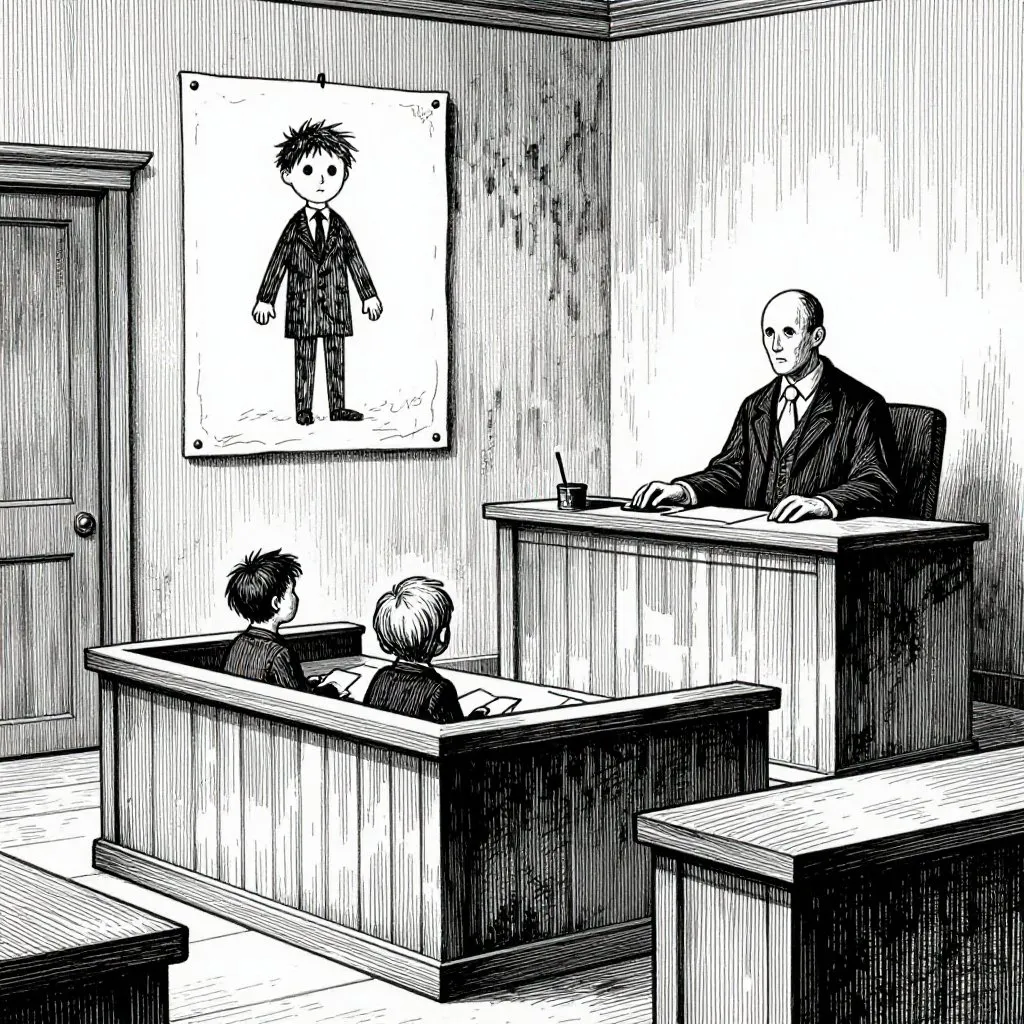
On May 31, 2014, in Waukesha, Wisconsin, two twelve-year-old girls lured a classmate into the woods and stabbed her nineteen times.
They told police they did it to appease Slenderman. They believed he was real. They believed he lived in a mansion in the Nicolet National Forest. They believed that killing someone would earn them the right to become his proxies, his servants, permitted to live near him in the woods. They had spent months planning it. They had told no one.
The victim's name was Payton Leutner. She was twelve years old. She crawled through the woods to a road, where a passing cyclist found her. She survived. The injuries were severe enough that she should not have, and the fact that she did is the only mercy in the story.
Both attackers were charged as adults. One was sentenced to twenty-five years in a psychiatric institution. The other received forty years. At the trials, the evidence included notebooks, internet search histories, and a shared internal world that had grown for two years without any adult noticing. The investigators, the psychologists, the journalists who covered the case all struggled with the same question: what happens when a fictional monster becomes, for some minds, entirely real? The internet had spent five years joyfully building the mythology without ever having to answer that.
There was no satisfying answer. There still isn't. The creators of the original stories and games were not responsible for what these two children did, and they were also not completely separate from it. The line between immersive fiction and harmful belief is a line that most people cross and return from without incident, and some people do not. The Waukesha case did not end the Slenderman mythology. It added a chapter to it, the chapter that nobody had wanted to write, and it changed the weight of every chapter that came before.
The Creator
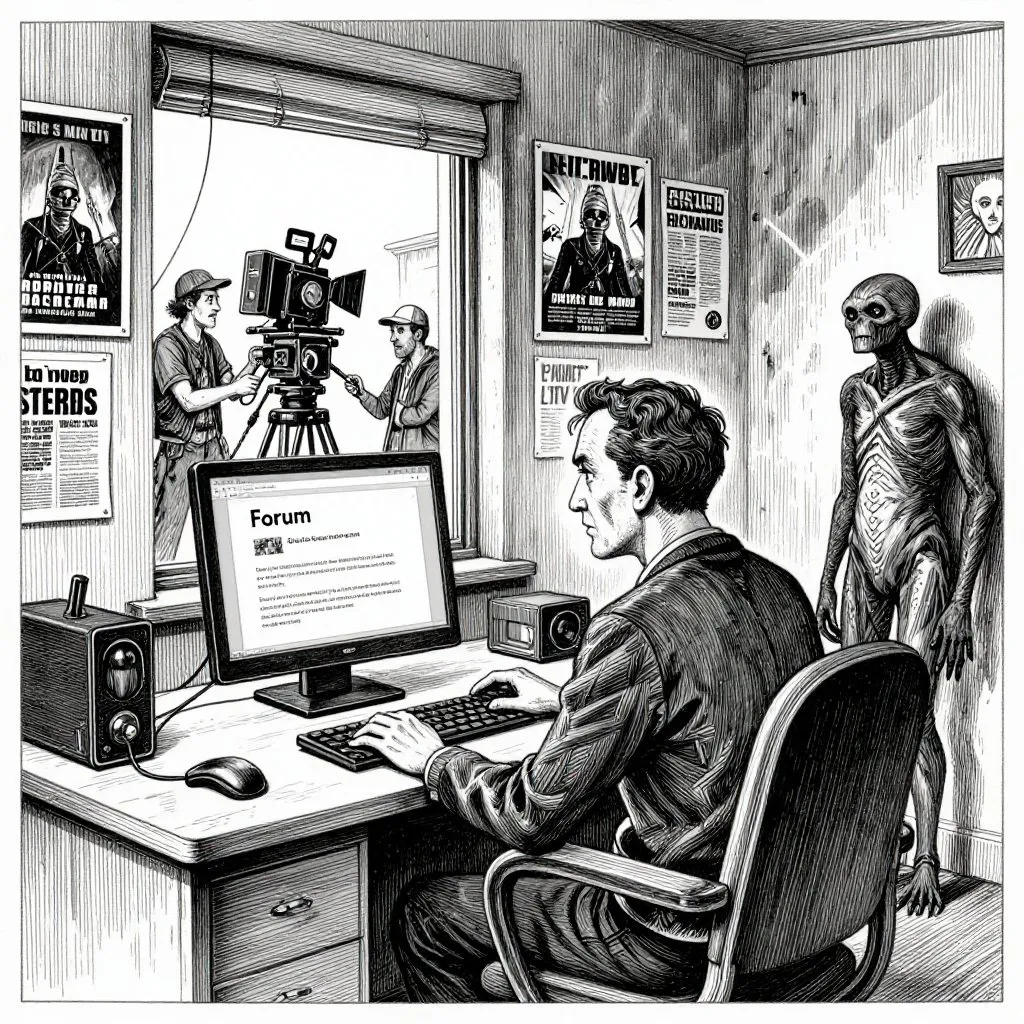
Eric Knudsen did not expect any of this. He made a Photoshop entry for a forum contest on a Tuesday in 2009 and watched what happened next from a distance, with what appears to have been a mixture of wonder and discomfort. He gave interviews over the years. He was careful in them. He acknowledged the original creation without claiming ownership over what the community had built from it, and he declined to accept responsibility for what others had done in the character's name, which was the only reasonable position and also a genuinely difficult one.
The 2018 Sony Pictures film "Slender Man" was released into theaters and received, by most measures, poorly. The critical response was near-unanimous. A 7% approval rating on Rotten Tomatoes is not a mixed reception. It is a verdict. The father of one of the Waukesha attackers issued a public statement objecting to the production while his daughter was still in psychiatric care. Knudsen received a licensing payment and declined to be involved. The film opened, played for two weeks, and left.
What Knudsen made in an afternoon in 2009 had, by 2018, inspired artwork by tens of thousands of people, two of the most-watched game genres on YouTube, an HBO documentary, a criminal trial covered by international media, and a feature film that nobody liked. He had wanted to make a good Photoshop entry. He made something that could not be unmade, which is a particular kind of creative achievement with no good name for it. The internet does not have an undo button. It has a lot of other buttons, and most of them make things louder.
The Lesson
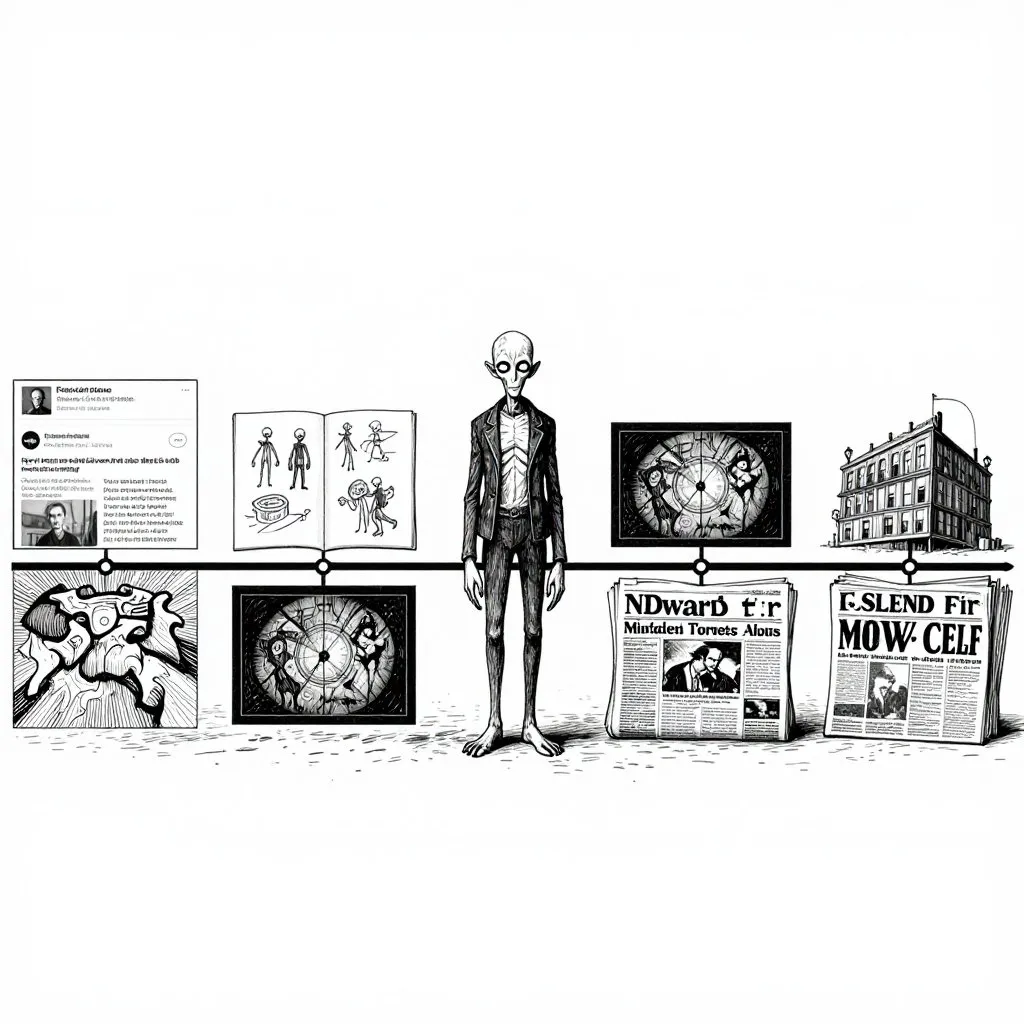
Slenderman is the first great monster of the internet age. He was not pulled from a lake or spotted on a mountainside. He was not handed down through oral tradition, refined across generations, adapted to new fears by storytellers who understood the specific anxieties of their time. He was designed in a single afternoon by one person, then completed by thousands of people who had never met, and he was finished before any of them understood what they were building.
He persists because the design was accidentally perfect. The blank face gives the viewer nothing to look at and everything to imagine. The impossible height makes architecture feel unreliable, as if any doorway could be wrong. The suit is the part nobody talks about enough: Slenderman wears a suit, which means he is not some creature from outside civilization but something that emerged from inside it. Something that got dressed. The stillness is the final element. He does not chase. He does not threaten. He is simply there, in the background, in the trees, at the edge of the photograph, and he has been there for a while, and he is not in a hurry.
Every generation gets the monsters it deserves. Previous centuries had their demons and their sea creatures and their figures waiting at crossroads. The twentieth century gave the world nuclear anxiety dressed as giant insects, and viral paranoia dressed as body-snatchers. Ours got a blank-faced man in a suit standing in the background of a Photoshop contest on a Tuesday in 2009, and within five years he had made it into a criminal trial, which is either a sign of extraordinary cultural resonance or a very efficient escalation path. Probably both.
He is still out there in the collective imagination, standing quietly between the trees. Not moving. Not threatening. Just there. Waiting for someone to look at the background of a photograph and notice something that should not be present. The contest ended a long time ago. He did not get the memo.
Field Notes
- Slender Man was created on June 10, 2009 by Eric Knudsen (username "Victor Surge") on the Something Awful forums as part of a paranormal Photoshop contest.
- The Waukesha stabbing occurred on May 31, 2014, when two 12-year-old girls stabbed classmate Payton Leutner 19 times. Leutner survived after crawling to a nearby road. The case was the subject of the 2016 HBO documentary "Beware the Slenderman."
- "Slender: The Eight Pages," a free indie horror game released in June 2012 by developer Mark Hadley (Parsec Productions), was downloaded over 2 million times in its first month and popularized the "found footage" survival horror genre in gaming.
- Slender Man is considered the first prominent example of "creepypasta" (internet horror fiction) to cross over into mainstream culture, inspiring academic study in digital folklore and participatory media.
- The 2018 Sony Pictures film "Slender Man" grossed $51 million worldwide against a $28 million budget but received overwhelmingly negative reviews (7% on Rotten Tomatoes) and was criticized by families affected by the Waukesha stabbing.
Dig Deeper
Want the facts behind the fiction? Explore the real history of Slenderman, from forum post to cultural phenomenon.
Learn more about Slender Man